

Space X? Space Why?
Elon Musk’s space company is about to list – should you buy shares?


SpaceX, Elon Musk’s, space exploration company, is about to IPO. An IPO is an Initial Public Offering, which means this is the first time we, the great unwashed, can buy shares in it. Should we? Here are five thoughts on (or around) the subject.
#1 What are you buying?
A share in SpaceX is a tiny slice of a company that launches things into space. It has its own reusable rockets, and has built the impressive Starlink - a web of satellites that’s brought the internet to otherwise inaccessible parts of the planet.
Beyond that, SpaceX has an even loftier ambition: to save the human race by making us “interplanetary”, and therefore not reliant solely on Earth.
If that wasn’t exciting enough, there’s also an AI angle: SpaceXAI. This includes all Musk’s AI bits and bobs, including X – the platform formerly known as Twitter – and the unappealingly named Grok and its offshoots (‘Grok’ is a Mars-based science fiction reference, which is cool to insiders but just one letter away from ‘grot’ for the rest of us).
Starlink is the part that’s currently bringing in the money – over $11bn in revenue. But all that’s being burned through, and more besides, by its spending on the AI infrastructure build out. On this basis SpaceX is currently a loss-making business. When it IPOs, it will seek to list at a value of $1.8 trillion, making it the biggest ever IPO and the seventh-biggest company on the planet.
It’s easy to be sceptical about all this. And as I prefer easy to hard, that’s what I’ll be doing for the rest of this article.
#2 Goldman Sachs recommends that you buy SpaceX shares
In my book, if Goldman Sachs thinks I should do something, that’s good reason not to do it. They are the lead underwriter for this IPO, so it’s their job to make it a success. They’ll get a decent slug of the purported $1bn Wall Street will earn from this IPO.
It’s beyond me why anyone would want to be a client of Goldman’s. It’s alleged to have referred to, and treated, its customers as “muppets”, and was fined for helping a hedge fund manager sell dodgy mortgage securities to Goldman clients before the financial crisis. And you’re not even their client, so lord knows what little they think of you.
If you’re buying SpaceX’s shares at IPO, you are relying on Goldman’s recommendation that $1.8tn is what the company is worth. Let’s leave it at that.
#3 Growing mangoes in Scotland
“We do not want humans to have the same fate as dinosaurs.”
This is SpaceX’s stated aim, and this is laudable. Who wouldn’t want to improve the odds of human survival? Not me – I’m pro-human.
It may well be that SpaceX can plant the seeds that lead to humans living on other planets, Star Trek style. But, and I’m sorry to be the thrower of cold water, this won’t be happening to you, or to anyone you know.
In my own scientific opinion, humans living freely on other planets any time soon is a pipe dream. (Caveat: my family regularly suggest – unfairly I think - that of the four branches of science; biology, physics, chemistry and pseudoscience, that I’m best qualified in the latter).
It will be bloody hard to establish a colony of humans on Mars, because we aren’t evolved to live there. It’s like growing mangoes in Scotland. It’s possible, but only with extraordinary expense, time and effort. And even then, you’ll produce a withered, pale, limp version of a mango compared to the luscious fruit that falls from trees in places they were evolved to grow, like Sri Lanka.
Further afield than Mars, we might even find a planet with near-identical climatic conditions to Earth (we haven’t yet). Forget how ridiculously far away such a planet will be, it will still take generations of Darwinian evolution (requiring huge numbers of deaths from bacterial infections, poisoning, gravity mishaps and god knows what else) for the fittest humans to adapt to anything approaching a natural life away from Earth. So don’t hold your breath (unless you’re outside on Mars, in which case definitely do).
There’s an irony here that Musk and/or SpaceX are prominent drivers of the three leading candidates for imminent human extinction: climate collapse; political acrimony leading to nuclear war, and the creation of a new Apex predator for planet Earth in the form of AI. Any one of these could wipe all humans well before we get one anywhere near Mars, let alone another galaxy. In other words, in trying to avoid the dinosaurs’ fate, we may condemn ourselves to exactly that.
#4 You’re probably going to buy shares anyway
You might hate the idea of buying SpaceX shares, but you’ll still end up owning them. Why? Because, somewhere among your financial products you probably own an index tracker. And if you own a global or US tracker, it looks likely they’ll be forced to own these shares. Which means you’ll own them.
This is a new development. There used to be a ‘seasoning’ rule, which meant new shares had to be listed on the market for a fair while before they got included in the index. This allowed the market to kick around the shares for a year or two, allowing them to find their true value as active investors bought and sold them. If a company was horribly overvalued at IPO, or worse an outright fraud, this might be discovered before it hit the index.
But the index providers have – suspiciously in my view – dumped this rule ahead of this particular IPO. So now funds tracking the NASDAQ and FTSE Russel indices will be buying in the first few weeks (there’s some vagueness about their timing), while S&P has said it won’t be changing its rules, so it won’t hit their indices for at least a year.
This has got the industry professionals I’ve spoken to interested. Many who otherwise wouldn’t have touched SpaceX with a barge pole are considering buying shares at IPO, then flipping them to the passive buyers (i.e. you) when they blunder in later at a higher price. There are plenty of non-professional investors with the same plan, of course, and there’s no reason why you couldn’t try the same trick yourself.
I’m not one of these professionals, by the way: I’m not buying SpaceX shares. I also don’t own index equity funds. I have lots of reasons for this, and this just adds to that list.
Which brings us to the original question:
#5 Should you buy shares in SpaceX?
I’m not going to. I never buy shares directly anyway. My own money is invested in a selection of funds managed by experts who pick shares for a living (I pick funds for a living, for reference).
In thinking about SpaceX, I’ll admit there were moments of temptation. Not least the passive-exploitation strategy I mentioned above. Although it’s worth noting here that whenever anything looks like a money-making dead-cert, the market often delights in doing the opposite. So I’m not recommending you do this either.
Beyond that, the only other aspect that tempts me is that all the hoopla and excitement could drive these shares a lot higher, even if SpaceX ultimately fails to deliver (either permanently or temporarily). I mean, look at Bitcoin, that’s literally nothing, and early buyers made a fortune from it. SpaceX is an actual company, and it’s doing some properly exciting, imaginative stuff. So, who knows? Maybe it goes to the moon.
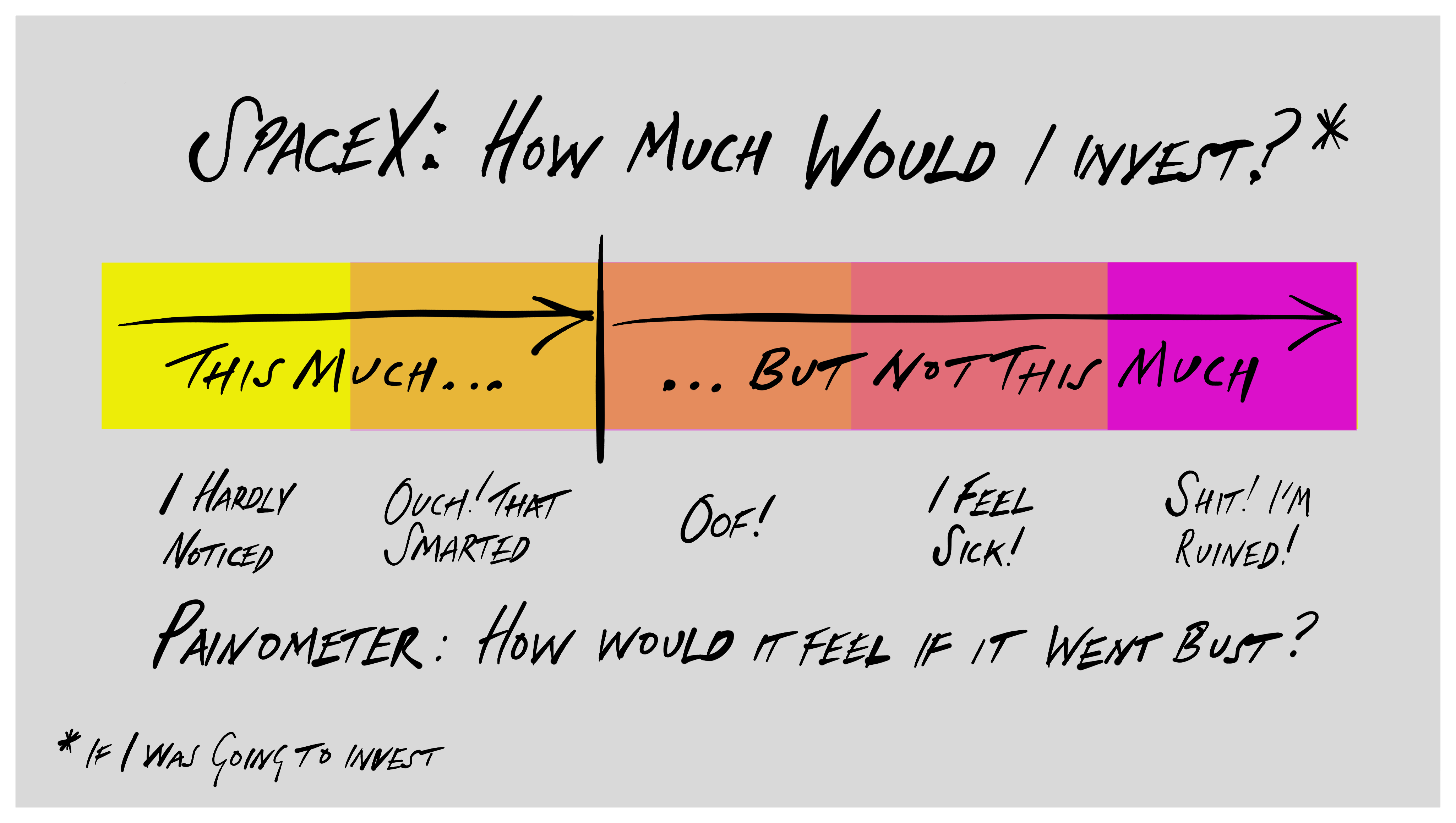
But the important point to make here is that, if I was about to buy shares, I’d only buy an amount that – if it went up in smoke - would feel somewhere between “I hardly noticed” and “ouch! that smarted.” If you’re thinking of putting in an amount that would sit anywhere beyond, say, between “I feel sick” and “shit, I’m ruined!”, then you might want to reconsider. Because no matter what you hear – for or against – nobody knows what SpaceX is worth, or what the future has in store for it.

SEC-Approved Insider Information
I wrote a similar piece to this in 2021 called “Should you invest in Bitcoin?”. In it I set out a 12-point investment decision-making process. I think this stands up well, and would work for SpaceX shares too:

The FT’s Unhedged podcast is one of my few regular listens. This episode covers the SpaceX IPO, and has some more info, opinions and angles. I particularly appreciated Katie Martin’s suggestion that the index providers abandoning their previous rules in the face of lobbying suggests the enshittification of passive funds.

This is a good and not-unrelated essay from fund manager Matthew Beddall of Havelock London, called ‘The Mother of All Bubbles?’. For yes, these are weird times we’re living through:


That’s all. Stay lucky.
Simon
Disclaimer
These are my own personal opinions for informational and educational purposes only and not financial advice. Nothing here should be treated as a recommendation to invest or take any specific action.
I’m not your financial adviser, and you should do your own research or seek professional advice before making decisions. Any reliance you place on this content is at your own risk, and I accept no liability for any losses incurred.
Brilliant! This is a great read. (The boys and I are considering proposing you for an honorary doctorate in pseudoscience)
Enjoyed it , helpful , no ‘clangers’ now from me on space X .